The Moral Right of Skateable Sculpture
Call for participation
Latest Feature:
Conference, to take place:
Henry Moore Institute, Leeds
Friday 19 March 2027
Deadline for proposals:
Friday 11 December 2026, 17:00
See the Henry Moore Foundation website for the full call for participation and event access infomation:
Submit a proposal:
We welcome submissions from a broad spectrum of critical and creative practice for individual 20-minute papers. Applicants are kindly asked to submit:
a brief abstract (no more than 400 words)
a short biographical note (100 words)
The deadline for proposals:
Friday 11 December 2026, 17:00
Please email your proposals to: research@henry-moore.org
If you would like to apply in another format, such as video or audio, this is also welcomed. Please contact research@henry-moore.org if you would like to discuss this.
Speakers will receive an honorarium of £125, accommodation, and travel costs within the UK will be reimbursed.
Civic Skateboarding was about forming better relationships between skateboarders and Leeds’ civic and cultural institutions in order to better protect one another. It paid particular attention to the growing number of female and minority gender skateboarders who are disproportionally affected by the lack of safety in public spaces and was co-created, co-curated, and co-skated by many members of the Leeds skateboard community. Read here.
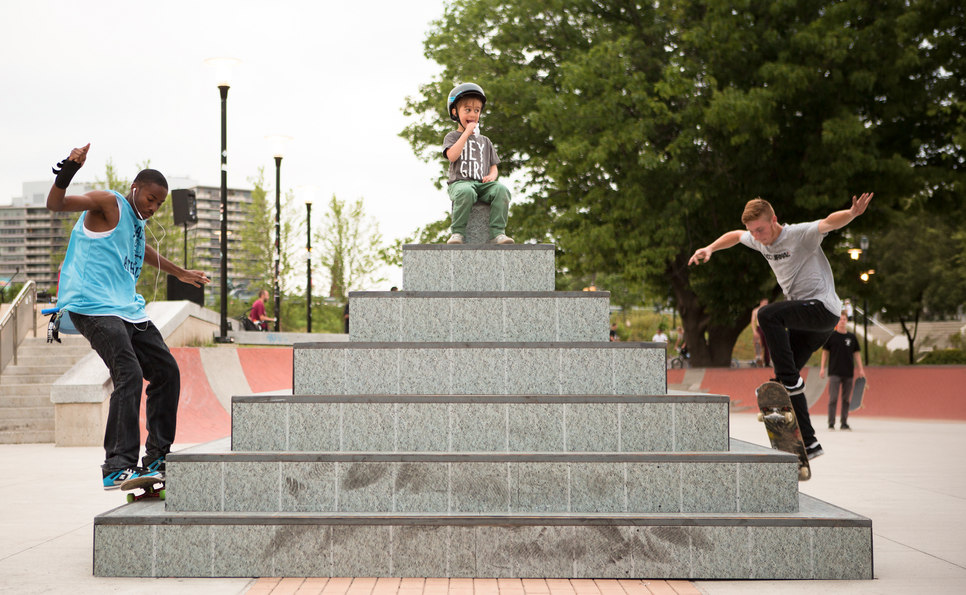
Jonathan Monk, Pyramid 2015. Photo: Steve Weinik.
The Moral Right of Skateable Sculpture will bring together academics, artists and skateboarders interested in the emergent field of ‘skateable’ sculpture.
In 1996, Vito Acconci, Stanley Saitowitz and Barbara Solomon’s Promenade Ribbon on San Francisco’s Embarcadero became a flashpoint for public space and skateboarding, sparking debate that led to the sculpture being ‘skate-stopped’. In response, at the 1997 ACSA European conference in Berlin, Joel Varland argued that prohibiting skateboarders from interacting with the work undermined the artists’ ‘moral right’. This is a legal term protecting an artist’s authorship over a work’s intended use. Since the sculpture’s conceptual intention was public interaction, Varland contended that restricting skateboarders breached this right, with debate over the Promenade Ribbon continuing to this day. Yet in the decades since, sculptures explicitly intended to be skated upon have proliferated across museums, biennials, skate festivals, and beyond, including at the Henry Moore Institute itself.
This symposium seeks to examine the recent history and contemporary moment of skateable sculpture. What new forms of artistic thinking, public interaction or critical response do these works engender, and what might it mean for an artwork to have the moral right to be skated upon?
This symposium is organised in collaboration with Dr Harry Meadley (Senior Lecturer in Fine Art, Leeds School of Arts, Leeds Beckett University).